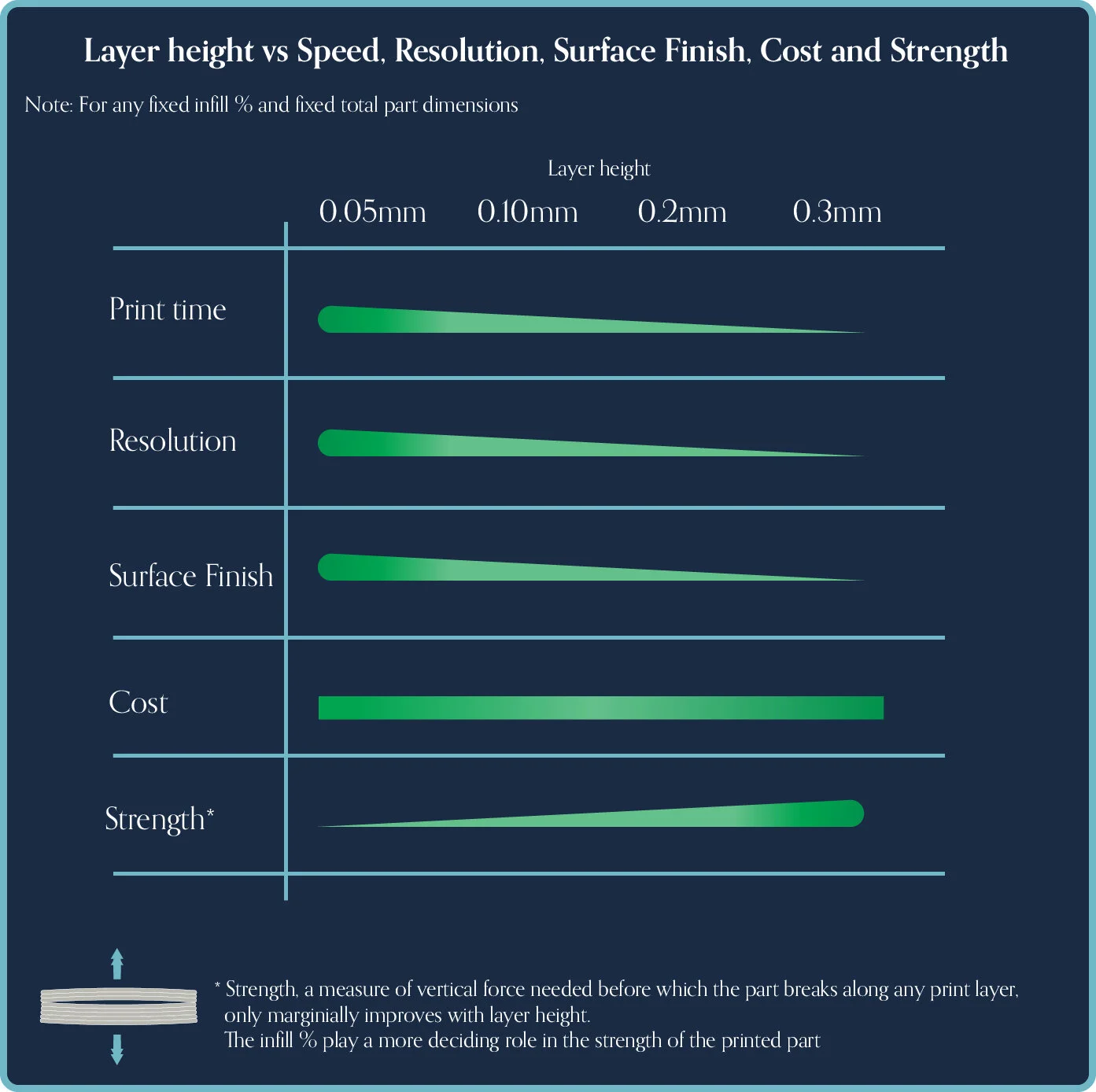
What layer height should I select? This is probably the first question that is asked as soon as a print model is loaded onto the slicer software. Rightfully so. Layer height choice indirectly makes several key decisions for you, namely: Print time, Resolution or clarity of smaller features, Surface finish or smoothness of print and finally the Strength.
In this post, I’ve focused mostly on providing a graphical and a numerical overview of what happens when the layer height is increased from 0.05 to 0.30mm. There are plenty of resources out there which discusses in details on which layer height should be chosen for different application and need so I will not delve too much into it. A general rule of thumb, however, will be to choose larger layer heights for mock ups and test prints and lower layer height for models, which has finer details and in need of a smoother finish.
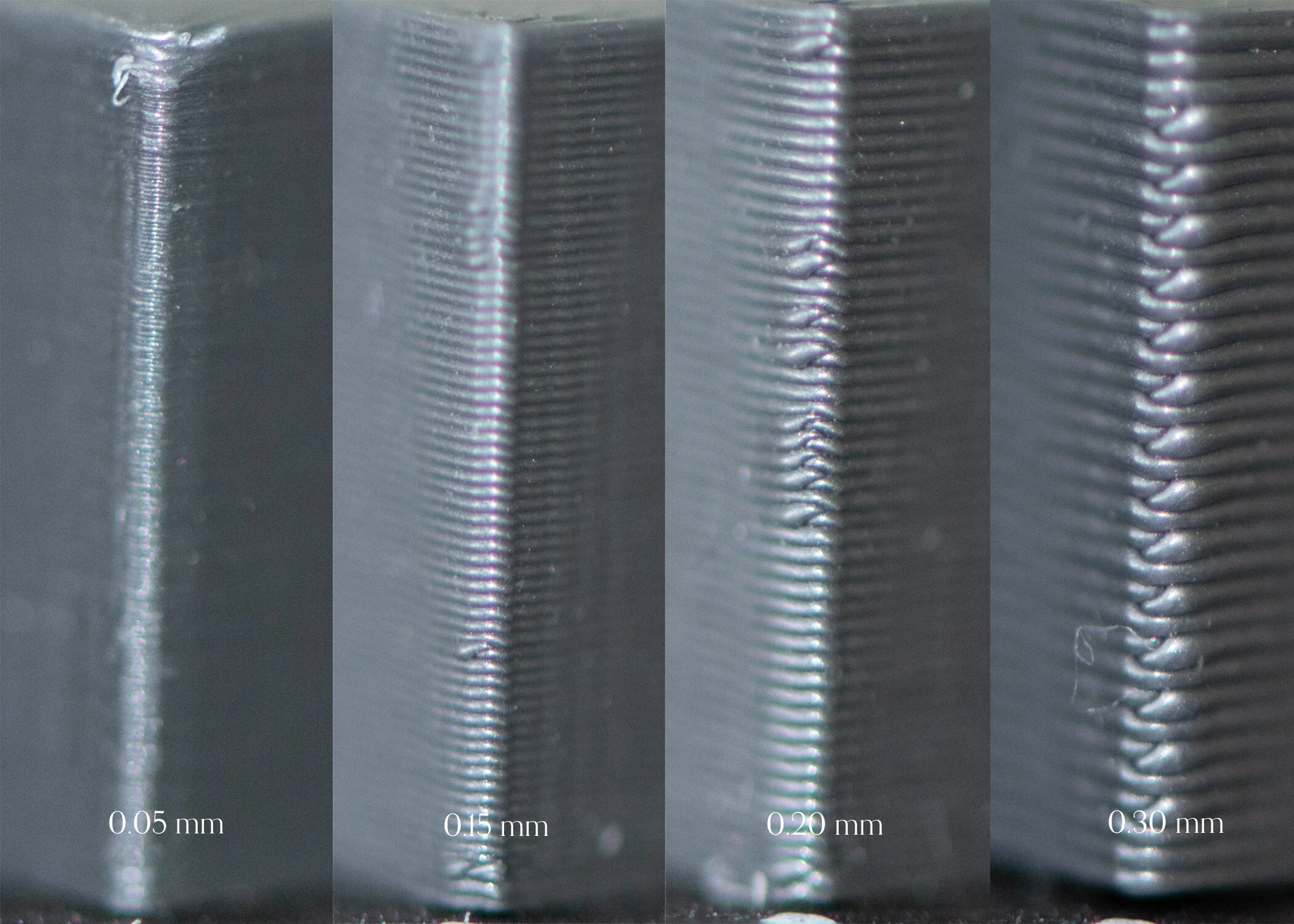
Lets start off with surface finish. The image above is a collage of edges of cubes printed with different layer heights, taken at a similar magnification. As the layer height increases, the individual print lines are visible and the finish deteriorates.
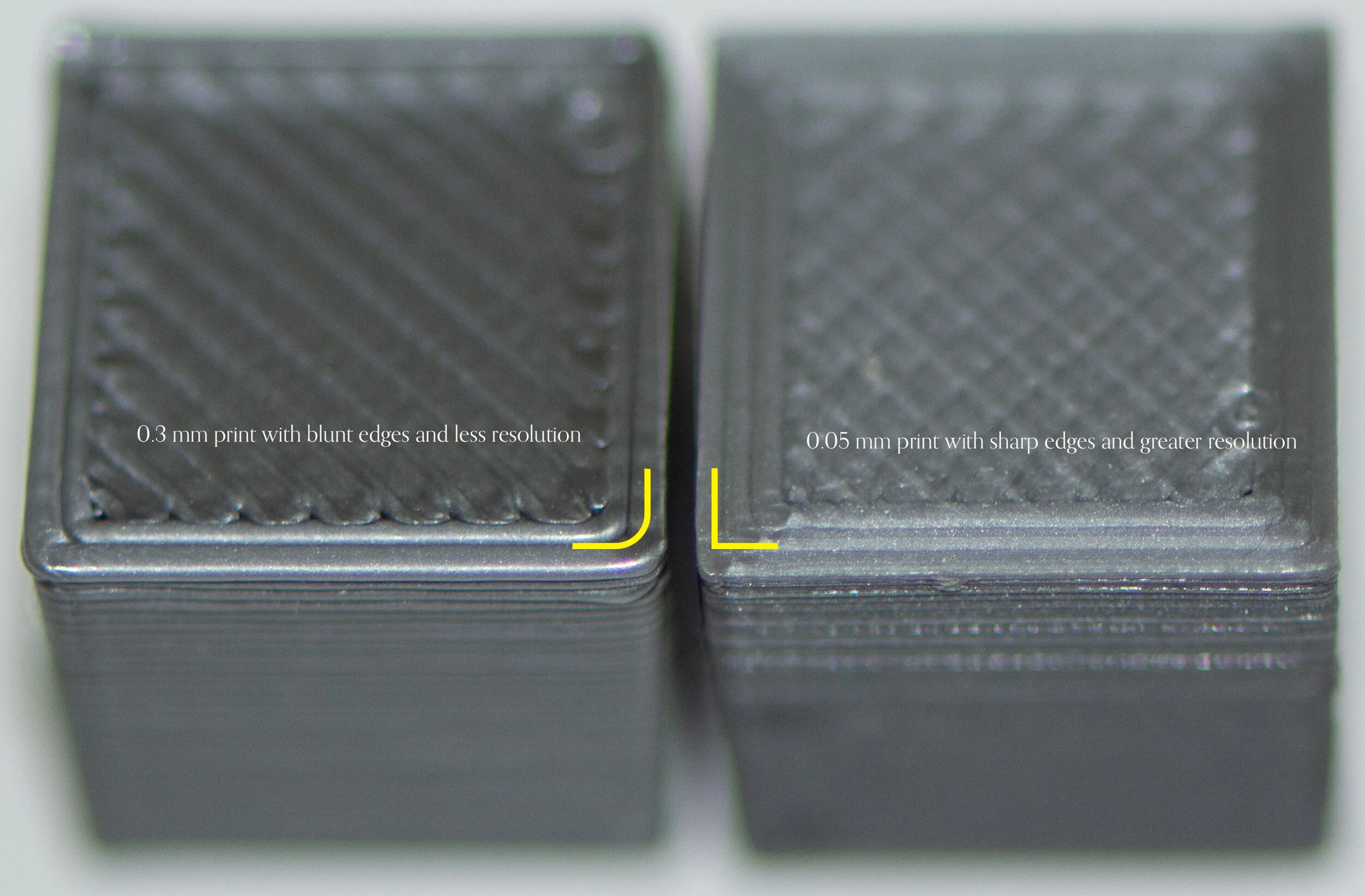
As for the resolution, when observing the cube from the top, the 0.05 mm print (right) gives a sharper refined finish and resolution compared to the 0.30mm print (left). This can be extrapolated to larger and more complex models too.
In terms of print time and cost, the following table shows the filament usage, its corresponding cost and the total print time. These numbers are for a 15% infill print with all other settings kept constant. Note the relatively drastic drop in total print time. The cost variance is insignificant and can be assumed to be the same across layer heights.
| Layer height (mm) | 0.05 | 0.10 | 0.15 | 0.20 | 0.30 |
|---|---|---|---|---|---|
| Used Filament (m) | 0.27 | 0.23 | 0.23 | 0.23 | 0.23 |
| Used Filament (mm3) | 649.5 | 559.03 | 564.18 | 564.95 | 732.56 |
| Used Filament (g) | 0.81 | 0.69 | 0.7 | 0.7 | 0.91 |
| Cost ($) | 0.02 | 0.02 | 0.02 | 0.02 | 0.02 |
| Time (mins) | 34 | 15 | 11 | 8 | 7 |
The discussion on strength of the printed part is quite broad and important and therefore I shall not gloss over it. A more in-dept study from my3Dmatter can be found here and is a must read for anyone looking to 3D print for functional uses.
If one would need a quick takeaway on the importance of layer height selection in 3D printing then let it be this infographics.